The Heroes’ Square & Andrassy avenue - 7Seasons Apartments Budapest - Accommodation in Budapest Centre

Home
Online booking
Arrival date:
Departure date:
CHECK RATES & AVAILABILITY
book online with instant confirmation
Reserve online or call us at: +36 20 274 7777


The Heroes’ Square


Category: Monument, edifice
Address: 1068 Budapest  Dózsa György út 106
Telefonnumber: 0036 1 269-5300


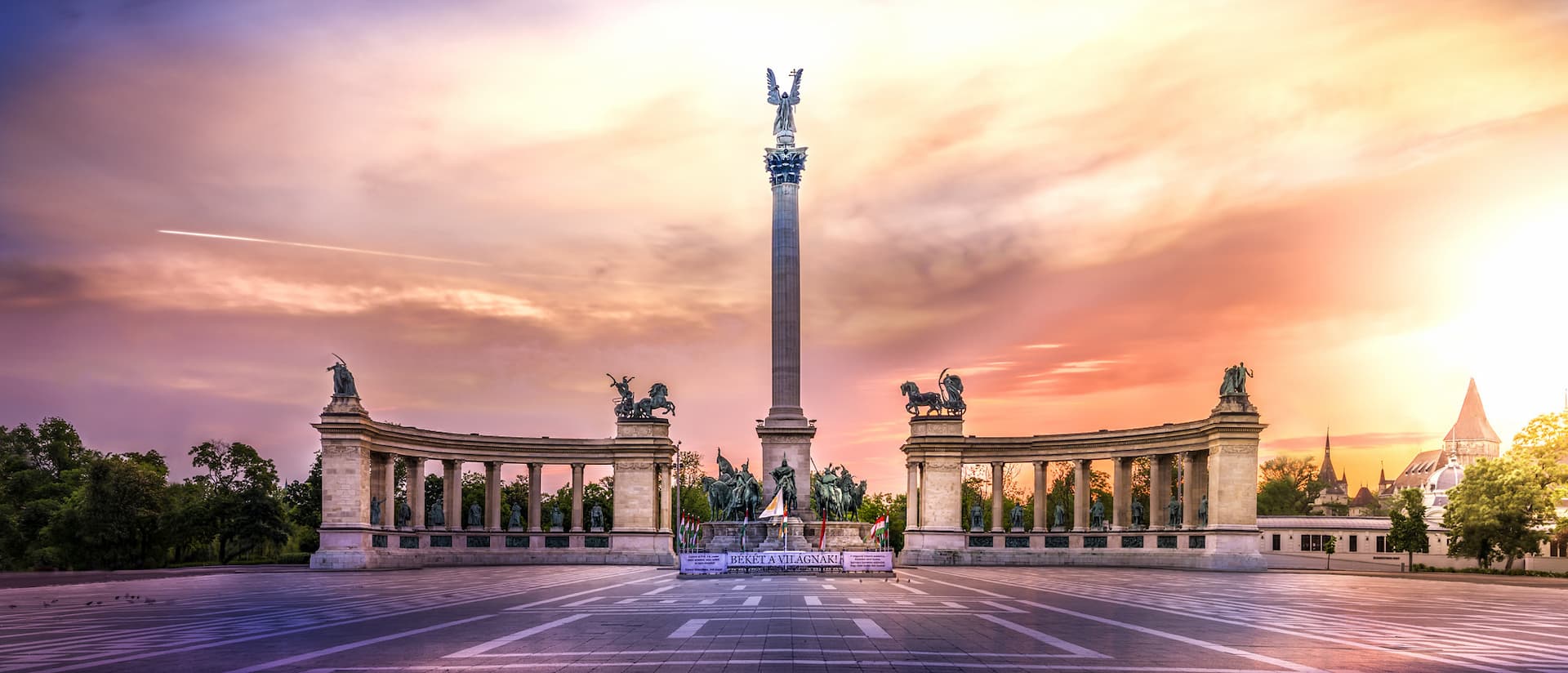
The Heroes’ square is one of the most visited sights of the Hungarian capital, i is situated in front of the City Park, at the end of the Andrássy Avenue, one of the most important streets of Budapest, a World Heritage site.


The millenial monument was built in 1896 to commemorate the 1000th anniversary of the arrival of Hungarians in the Carpathian Basin. The monument consists of two semi-circles on the top of which the symbols of War and Peace, Work and Wellfare, Knowledge and Glory can be seen.  The niches are decorated by the statues of kings, governors and famous characters of the Hungarian history. At the foot of each statue a small relief depicts the most important moment of the life of the personality.


In the middle of Heroes' square stands a 36 metres high corinthian column with the statue of Archangel Gabriel on the top, the symbol of the Roman Catholic religion. At the pedestal the equestrian statues commemorate Árpád and the seven chieftains of the Hungarian tribes, who settled their people in the present territory of Hungary. His decendants formed the Hungarian royal dinasty.


The tomb of the unknown soldier can also be found in the square. At the two sides the representative buildings of the Museum of Fine Arts and the Art Gallery both worth a visit. Since the last couple of years, the two museums have been competing for the attention of visitors with high standard temporary exhibitions, such as Van Gogh, Rembrandt and the collections of Spanish and French paintings.


Andrassy avenue


Andrássy Avenue is an iconic boulevard in Budapest, Hungary, dating back to 1872. It links Erzsébet Square with the Városliget. Lined with spectacular Neo-renaissance mansions and townhouses featuring fine facades and interiors, it was recognised as a World Heritage Site in 2002. It is also one of Budapest's main shopping streets, with fine cafes, restaurants, theatres, and luxury boutiques.


It was decreed to be built in 1870, to discharge the parallel Király utca from heavy traffic and to connect the inner city parts with the City Park. Its construction began in 1872 and the avenue was inaugurated on August 20 (a national holiday), 1876. Its realization was a blend of the plans proposed by the top 3 competitors Lajos Lechner, Frigyes Feszl and Klein & Fraser. Its palaces were built by the most distinguished architects (led by Miklós Ybl) of the time, financed by Hungarian and other banking houses. These were mostly finished by 1884 and mostly aristocrats, bankers, landowners and historical families moved in. It was named in 1885 after the main supporter of the plan, Prime Minister Gyula Andrássy.


The construction of the Budapest Metro, the first underground railway in Continental Europe, was proposed in 1870, since the capital had always been opposed to surface transport on this road. Construction began in 1894 and was finished in 1896, so this new metro line could facilitate the transport to Városliget, the main venue of the millennium celebrations of Hungary.


Cross-section of the first metro line under Andrássy út, 1890s
The boulevard was renamed three times in the 1950s; a testament to the rapid political changes of the period. It became Sztálin út ("Stalin Street") in 1950 during the Soviet occupation. During the 1956 uprising it was renamed to Magyar Ifjúság útja ("Avenue of Hungarian Youth"). The following year the governing communists changed the name to Népköztársaság út ("People's Republic Street"). The former name of Andrássy was restored in 1990, after the end of the communist era.


Share Pin It
email